According To Smoky
Winter cooking can steal your energy
and your heat.
Be sure to fight back!
Welcome to According to Smoky. Here you will find the latest and greatest from C. Clark "Smoky" Hale notable 'baster', author, publisher, television star in both the barbecue and 'the real' world. And yes, he is a real person and not the webmaster
Smoky will be offering his talents, techniques and secrets discovered over the last 150 years, or so. He will be to the point, pull no punches and if you suffer through the process, you will become a much better outdoor cook, turning out masterpiece meals for friends and family alike.
In this column, Smoky shows you how to keep your heat up without overheating! He will provide a unique insite into winter cooking. . . . take notes!
So, with no further adieu, we turn the mike to Smoky. You're on Smoky . . . . .
Thanks PC
 OUTDOOR COOKING WITH SMOKY HALE OUTDOOR COOKING WITH SMOKY HALE

A short time ago, Yankees, food writers and mass
merchandisers considered that Labor Day was the end of the outdoor
cooking season. Now days, even Yankees know better. Knowledgeable
Canadians don't let a little snow interfere with their plans to fire
up the grill outdoors. We can't control the weather, but we can keep
it from controlling us.
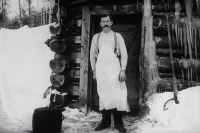 Personal comfort can be managed by dressing the part, letting
the grill do its work outside while we stay toasty inside. However,
the real key to successful winter time cooking is controlling the
heat inside your cooker. The meat doesn't care what the temperature
outside the grill, only what comes to it. So if you maintain the
internal temperature, cooking times will not vary. Maintaining that
temperature is the challenge. Personal comfort can be managed by dressing the part, letting
the grill do its work outside while we stay toasty inside. However,
the real key to successful winter time cooking is controlling the
heat inside your cooker. The meat doesn't care what the temperature
outside the grill, only what comes to it. So if you maintain the
internal temperature, cooking times will not vary. Maintaining that
temperature is the challenge.
Water, in any form, and wind steal BTUs like a band of
bandits. Maintaining the desired temperatures in the grill/pit
requires more fuel to offset the lower ambient temperature. That is
not too big a chore in still, sunny weather, regardless of the
thermometer reading. But protection from wind and water is essential
for relaxed cooking in nasty weather.
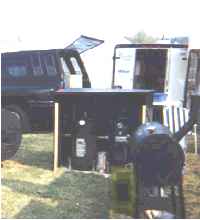 Regardless of the season, every barbecuer and griller should
have some sort of overhead shelter, however impermanent, to protect
from precipitation, liquid or solid. Water is many times more
effective than wind in soaking up heat, so shelter from precipitation
is essential. Pop-up canopies are relatively inexpensive, go up
easily and if not burned up or allowed to blow away, can last for
several years. Panels that attach to the sides will break the wind,
not only reducing the heat loss, but making it reasonably comfortable
for the cook and friends to hang around the pit. Your neighbors may
not appreciate it, but I have made temporary shelters of PVC pipe,
polyethylene and duct tape out at the hunting camp that worked very
well. Regardless of the season, every barbecuer and griller should
have some sort of overhead shelter, however impermanent, to protect
from precipitation, liquid or solid. Water is many times more
effective than wind in soaking up heat, so shelter from precipitation
is essential. Pop-up canopies are relatively inexpensive, go up
easily and if not burned up or allowed to blow away, can last for
several years. Panels that attach to the sides will break the wind,
not only reducing the heat loss, but making it reasonably comfortable
for the cook and friends to hang around the pit. Your neighbors may
not appreciate it, but I have made temporary shelters of PVC pipe,
polyethylene and duct tape out at the hunting camp that worked very
well. |
Continued on Page 2

Smoky's 5th basic position for really great barbecue'n.
'According to Smoky' is © by C. Clark Hale
who is solely responsible for its content. Comments
should be addresses to cchale@bellsouth.net |










 Subscribe now to The Smoke 'N Fire Enquirer, the Internet's most popular backyard grilling and barbecuing on-line tutorial and we'll send you FREE recipes, techniques and tips for preparing the finest outdoor meals. FREE! See a