image
image

According To Smoky


A Glossary of Outdoor Cooking
Words and Terms

Welcome to According to Smoky. Here you will find the latest and greatest from C. Clark "Smoky" Hale notable 'baster', author, publisher, television star in both the barbecue and 'the real' world.

Smoky will be offering his talents, techniques and secrets discovered over the last 150 years, or so. He will be to the point, pull no punches and if you suffer through the process, you will become a much better outdoor cook, turning out masterpiece meals for friends and family alike.

He begins our education with some important definitions in order for everyone to begin on the 'same page'. Each month he will be offering more information than you can get on a large size grill. We will archive each article so viewers can catch up with him. So, with no further adieu, we turn the mike to Smoky. You're on Smoky . . . . .

  1. Smoky's Glossary of Barbecue Terms.
  2. Smoky's Technique for Better than Restaurant Steaks!
  3. Smoky's Artful Hamburger & Great Wieners.
  4. Smoky's Holiday Ham Issue.
  5. Smoky's Smoke-Cooked Turkeys.
  6. Smoky's Mary had a Little Lamb.
  7. Smoky's Heat!
  8. Smoky's Valentine Breasts
  9. Shoulders & Butts
10. Smoky Gives You The "Tongue"
11. Smoky's Broiled Catfish
12. Smoky's Country Sausage
13. Smoky's Current Column


Thanks PC,

Smoky HaleWhen I barbecued my first whole beef, Jacques Cousteau was still wearing water wings. I continued to barbecue and thought everybody else did until a good friend fractured that fantasy in the early '80s. I tried to buy a good book on barbecue as a gift for him. All I found in print was pretentious pap, prissily penned by pompous magazine food editors who didn't know barbecue from burgoo. To remedy that unacceptable condition, with the help of competent old basters and hard research, I produced "The Great American Barbecue Instruction Book," in 1985. In response to questions that kept coming, I wrote a weekly newspaper column on outdoor cooking for a few years and sort of become a non volunteer missionary for truth in barbecuing.

Central to the code of barbecuing is the canon of sharing. It is, in order to share, that barbecuers always cook more than they and their families can consume. The code also requires that those of us, to whom the basting mops were passed by the ancient keepers of the coals, share our knowledge of the art and science of barbecue.

When there were enough old basters, we could personally reach out and teach anyone who wanted to learn. We only paused to snigger at the modish melanges of meats and faddish fruits, grouped on a grill and artfully glistened with glycerin by fawning food stylists, and proffered as barbecue. We were content to let them simmer in their own catsup confections. But the metrics of Malthus no longer allow us the luxury of personal contact with all who really want the truth.

Therefore, we will use the newest technologies to pass along the ageless truths about outdoor cooking. I pledge to do that to the best of my ability and let the ashes fall where they may.

A barbecue

On occasion upon which food is barbecued.

Barbecue

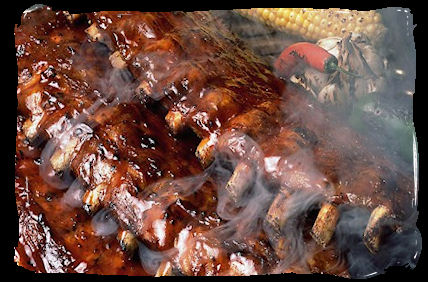
Meat cooked in the dry heat of wood coals at temperatures around the boiling point of water (212*F at sea level). An essential distinction from other forms of cooking is the temperature at which it is cooked. The lower temperature allows the meat to become tender while preserving its natural juices and the exterior does not dry out before the center becomes done. The long cooking period allows for myriad savory seasonings and provides ample opportunity for pleasurable activities. The consummate barbecuer excels in the latter as much as the former.

Roasting over coals at temperatures in the 250-450*F range has been going on since mankind learned that meat tastes better:

(1) without the grit and ashes picked up from throwing it directly upon the coals.
(2) cooked over wood coals after the flames and smoke of noxious gasses have departed.

Broiling, 475-700*F, has only gained popularity since we started penning up range fed cattle and clogging up their arteries with cholesterol while adding enough fat interspersed with their muscle so that certain parts became chewable after quick cooking. Only cuts of beef from little used muscle are tender enough for broiling. The same goes for chicken. If you doubt me, find an organically grown, range fed chicken and throw it on the grill for broiling. Do that often enough and you will develop jaw muscles that even Arnold would envy.

Barbecue has been going on since certain southerners with a distinct fondness for strict compliance with the laws of conservation of energy discovered that a whole hog could be rendered tender, delicious and healthier by long, slow cooking while basting with a seasoned sauce.

Barbecue Grill

An appliance for cooking meat over wood coals or charcoal which allows the temperature to be maintained in the 190-225*F range.

Barbecue, Origin of

Many years of research has convinced me that barbecue probably began in North Carolina. An anonymous tract published in London in 1666, entitled "A Brief Description of the Province of Carolina" stated "hogs find so much mast and other food in the woods that they want no other care than a swineherd to keep them from running wild." William Byrd kept a daily journal during his survey of the boundary of North Carolina and Virginia, 1728-29, and published it as "History of the Dividing Line." In it he observed regarding the inhabitants of the region, "The only business here is raising of hogs, which is managed with the least of trouble and affords the diet they are most fond of. The truth of it is, the inhabitants of North Carolina devour so much of the swine's flesh that it fills them full of gross humors." He further noted, "For want, too, of a constant supply of salt, they are commonly obliged to eat it fresh and that begets the highest taint of scurvy.."

The conditions, therefore, were (1) abundant hogs requiring no upkeep, (2) the necessity for cooking the whole hog, lest it spoil from insufficient salt for curing. (3) The threat of scurvy which is the result of lack of vitamin C.

Citrus fruits, which were the main source of natural vitamin C, were as scarce as salt in the pioneer wilderness. Peppers are several times richer in vitamin C than citrus, and, more importantly, available. Vinegar, rich in acetic acid - a natural bactericide , was the cheap and readily available. (A Vermont doctor has written a book and made a career preaching the health benefits of apple cider vinegar.)

And, the long, slow cooking process suited the North Carolinians life style as described by Byrd.

Vinegar, water, salt and peppers still constitute the basic barbecue basting sauce in North Carolina. South Carolinian's added mustard. Georgian's and Virginian's added catsup. As it moved westward, all manner of ingredients were added.

Barbecue, Origin of the Word

H.L Mencken in The American Language, 1919, said that the word, barbecue, was in common usage in Virginia and the Carolinas by the 1660. He attributes the source as a Taino word "boucan" which meant a rack of green wood. Taino were Arawakan Indians who inhabited Puerto Rico, Hispanola and the eastern tip of Cuba and were considered to have become extinct by about 1610. The French used that word as the root of buccaneer - a pirate. Authoritative Spanish dictionaries show the word "barbacoa" to be of American origin. And give its meanings as "1. Barbecue, meat roasted in a pit in the earth. 2. A framework suspended from forked sticks."

Webster's defines barbecue as "meat broiled or roasted over an open fire." ( How many errors can you find in that sentence?) He apparently followed the English (bless their pallid palates) lead. Alexander Pope, in Second Satire of the Second Book of Homer, ca 1735. wrote".., send me, Gods! A whole pig barbecued!" He later defined barbecue as "A West Indian term of gluttony, a hog roasted whole, stuffed with spices and basted with Madeira wine." Pope should have heeded his own advice: "A little learning is a dangerous thing..."

As to the origin of the word, only Mencken is half right. I recently had the good fortune to correspond with Peter Guanikeyu Torres, President and Council Chief of the Taino Indigenous Nation of the Caribbean and Florida. He not only assured me that the Taino were alive and well, but also translated "barbecue" from Taino language as follows: Ba from Baba (father) Ra from Yara (place) Bi from Bibi (beginning) Cu from Guacu (the sacred fire) Or "the beginning of the sacred fire father." He further explained that "Taino barabicoa" means "the stick stand with four legs and many sticks of wood on top to place the cooking meat." He advised that "Taino Barabicu" means "the sacred fire pit." According to Chief Peter the Timucua, Guacara and Calusa tribes of the Southeastern United States were Taino who had migrated from the Caribbean with their culture. Paintings by Jacques le Moyne, in 1564-65, depicted Timucuans roasting game and fish on a rack of wood illustrate, according to Chief Guanikeyu, the Taino barabicu. The chief agrees with me that the meat was being roasted, rather than barbecued. Fact is, I find no more similarity to real barbecuing in the method of the Taino and the cast-off boucaneers than that of Achilles when he and his friends, Patroclus and Automedon entertained Ulysses and Ajax on the beach at Illium.

"Patroclus did as his comrade bade him; he set the chopping block in front of the fire and on it he laid the loin of a sheep, the loin also of a goat and the chine of a fat hog. Automedon held the meat while Achilles chopped it; he sliced the pieces and put them on spits while the son of Monoetius made the fire burn high. When the flame had died down, he spread the embers, laid the spits on top of them, lifting them up and setting them upon the spit racks; he sprinkled them with salt. When the meat was roasted, he set in on platters and handed bread round the table in fair baskets, while Achilles dealt them their portions." Iliad, Homer, Book IX, Lines 205-224

Paintings and illustrations made in the Southeast between 1564 and 1585 show Native Americans, from Florida to Virginia, cooking all manner of meat upon racks of wood. Indians were still in North Carolina when Byrd made his journey. He even recorded that one of his party had a nightmare in which he feared that the Indians would "barbecue" him.

The French claim "de barbe et queue," very loosely translated as "from beard to tail" is flagrantly fatuous franco-poop. If Catherine de Medici had not sent for her Florentine chefs when she became queen of France, the French would probably still be groveling for gruel.

In any case, none of this has anything to do with barbecue. Barbecue is not roasted.

Barbecue Pit

A hole in the ground containing wood coals over which a grill or rack to hold meat is placed for barbecuing. A brick or masonry construction for containing coals over which meat is cooked on a grate or rack. A large, portable metal construction for the same purpose.

Baste, Basting Sauce

Along with low temperature, the real secret of barbecue. The proper basting sauce flavors and tender the meat while keeping the exterior moist while the inside cooks. Basting sauces should be built to fit the meat. Meat without fat interspersed requires oil in the basting sauce. Fat pork, etc., doesn't need any additional oil. Likewise, the seasoning should fit the meat. A young lamb should be seasoned more delicately than an old beef.

Brisket

A tough piece of meat from the front of a cow's chest best used as corned beef. This started out as a Texan joke on tenderfeet Easterners and it backfired on them. They had planned to ship out the tough cuts along with the noxious weed, mesquite, and save the tender steaks and roasts for themselves. They hawked it so highly that folk expected to see it cooked when they went to Texas. Therefore, Texans had to start cooking and eating it. Brisket costs more than sirloin tip roast, is tougher, less tasty and loaded with fat. For the same amount of time, less money and less bother, you can have a good piece of meat.

Broil

To cook tender cuts of meat over hot coals at temperatures varying from 350 for chicken breasts to 700 degrees for thick steaks. Hamburgers, hotdogs, chops, shish kabob, etc. are broiled. The high heat seals in the flavor and juices which are retained if the meat is not over cooked.

Charcoal

The remains of wood which has had the moisture and volatile gasses driven off by being burned in an atmosphere deprived of sufficient oxygen to blaze. Charcoal can be no better than the wood from which it was made. The best charcoal for outdoor cooking is made exclusively from hardwoods bound together by pressure and a starch binder. Some big name brands use anthracite coal (ech!) and some use clay as a binder. Others use any available wood.

The horse puck design came from Henry Ford. It readily suited the coal tongs which his blacksmiths and machinists used.

It advantage for us is the same as for the folks in India where it is still the main cooking fuel. It has less weight (mass) and volume than wood and doesn't take as long to reach the proper conditions for cooking. If you have wood, use it to your advantage.

Cooker

See Barbecue Grill, Barbecue Pit, Grill

Dry Rub

A mixture of salt and seasonings which is rubbed into the surface of meat, usually pork spare ribs, before the meat is placed on the grill. Originated along the Memphis, TN - Kansas City, MO axis. Some also baste with a basting sauce. Now also adopted by cookers of brisket. May be placed on the meat minutes or hours before cooking.

Not suitable, by itself, for meat requiring long cooking periods because the exterior of the meat dries unless it is very fatty. This shortcoming was first discovered by a Dane of some notoriety, who according to Billy Bob Shakespeare, said, "Aye, there's the rub."

Grill, n

1. A rack, over a heat source, upon which food is placed for cooking. 2. An appliance, constructed of metal, ceramic or clay products, used for cooking over a heat source, which contains a rack for meat and a grate for the coals. It may be uncovered and as simple as a brazier or hibachi or it may incorporate a large firebox, removed from the meat rack which could allow broiling, roasting, barbecuing and smoking to be conducted simultaneously. The price may vary from $2.99 to $5999.00 for a backyard grill.

Grill, v

To cook food on a grill or grate over a heat source. Grilling may include broiling, roasting, barbecuing, smoking, drying, baking or steaming. In normal use among knowledgeable people, it normally means to broil items such as burgers, weenies, steaks, shish ka bobs, shrimp. etc.

Grill, Electric

An appliance containing a meat rack or grill over an electric heating element. Works the same as the broiler in an electric stove.

Grill, Gas

An appliance containing a gas fired burner under a grill or grate for food. Clean, convenient gas grills are excellent for broiling burgers and weenies and even steaks if they produce enough heat (minimum of 30M BTUs). If they have separately controllable right and left burners and enough volume under the lid, they can be used to roast.

With the lid closed, it works just like your gas oven. With the lid open, it works just like the broiler in a gas stove.

You can barbecue in a gas grill to the same degree that you can barbecue in your gas range.

Heat, n.

Regardless of what you have heard or read from pseudo pit masters, there is no "direct heat," there is no "indirect heat". There is only heat.

According the to irresistible laws of physics, heat moves from regions or objects of higher temperature to regions or objects of lower temperature until a state of equilibrium is reached. Heat moves in only three ways, by conduction, convection or radiation.

Conduction is the transfer of heat by intimate contact - who said physics couldn't be fun - and moves from molecule to molecule. For example, the grate or grill upon which the meat rests, having a higher specific heat than the meat, conducts heat to the meat. That is why, when the grill is right, that the beautiful brown stripes magically appear upon the surface of a steak. Then the exterior of the meat conducts heat to the interior, molecule by molecule. Conduction is extremely important in barbecuing because we must conduct the heat from the exterior to the center so slowly and gently that we do not dry out the exterior. Using low temperature over the long period is the essential distinction of barbecue from roasting or broiling. Not just incidentally, it also allows for more flavoring and more fun time. Let's hear it for conduction!

Convection is the transfer of heat by movement of heated masses, i.e. air, water, oil. In an oven, an enclosed grill or in the path of heated air, convection is at work. Convection allows us to remove the meat from directly over the coals and, therefore, tend the coals without disturbing the meat. It does not restrict the amount of meat which can be simultaneously cooked to the surface area of the coal bed and fat dripping from the meat does not drop into the coals.

Radiation is the transmission of heat in waves of energy resulting from vibration of excited molecules. As when your tongue trembles at the taste of succulent, savory barbecue, it radiates ecstasy to your brain and other pleasure receptors. In a closed grill, meat receives radiated heat from the coals, if it is over them, and from the heated mass of metal in which it is enclosed.

This may be more than you really want to know about it, but "the intensity of the radiated heat is directly proportioned to the temperature of the source and inversely proportioned to the square of the distance." In practical terms, this means that meat on a grill over coals and below a metal cover may receive equal radiated heat from both. Those who have cooked on a grill with tiered racks have no doubt observed that those pieces of meat on the top rack (nearest the metal) may brown more quickly than those on the lowest tier directly over the coals. Likewise, if you put bread on the top shelf of an oven, the top browns faster than the bottom, and conversely.

Microwaves are not, strictly speaking, heat. They generate heat within meat by the agitation of its molecules of water. This is the only cooking (?) process in which meat does not depend entirely upon conduction from its exterior to raise the temperature in the center.

As a practical matter, in an enclosed grill, unless meat is suspended from or resting upon a non conducting surface, it is at all times receiving heat by all three transfer methods.

What does all this mean to the barbecuer or the griller? Meat does not care how it receives the heat. What is essential in barbecuing is that the exterior of the meat does not over cook, dry out, burn, blacken or char before the interior reaches an acceptable temperature. This requires that meat receive a constant flow of heat, in any form or forms, at a temperature low enough to permit conduction, within the meat, time to work.

In this respect, water is the great ally. Water absorbs and conducts heat much better than dry tissue. Therefore, the more moisture that we can retain within the meat, the faster it will conduct and the more tender it will be when it is finished. Everybody knows that, at sea level, water boils at 212 degrees Fahrenheit. It, therefore, follows that, if we keep the temperature of the exterior of the meat at slightly below the boiling point of water, conduction is improved and tenderness is retained.

For a barbecuer, the effective grill is one which will allow its operator to present heat by all three forms in a controlled fashion over long periods of time and have ready access to the meat and to the coals. The greater the mass of the cooker and the coal bed, the more consistent the transfer of heat and the more time for enjoying all the ancillary activities for which barbecue has become famous.

In the final analysis. There is no direct heat. There is no indirect heat. There is only heat. The judicious use of heat in any form and the creative use of the time during which it is applied is what barbecue is all about.

Pit roasting, v.

To cook meat and/or vegetables in a hole in the ground. A large fire is burned down in a pit and, using various methods, part or all of the coals are removed, the meat is wrapped, placed in the pit and covered with various materials including some of the coals and allowed to cook much like a pot roast.

Roast, n

A piece of meat suitable in size and provenance to be roasted.

Roast, v

To cook large pieces of large animals or whole smaller animals in dry heat at temperatures ranging from 300-450*F. Normally meat chosen to be cooked in this fashion are the more tender parts or specimens. Meat may be basted to prevent drying. Meat from naturally fed animals may require larding, introduction of fat through the meat with special needles, and barding, covering with layers of fat, to render it tender.

Smoker

1. A compartment of or a whole railroad car to which gentlemen retire for an after dinner cigar.
2. A seedy night club where elder males of prurient interests congregate.
3. A structure or construction where in meat is placed to be cured by smoke.
4. One who smokes.
5. An appliance or structure for smoking meat as opposed to cooking it.

Smoking, v

1. Inhaling the smoke from smoldering tobacco leaves - the Native Americans' revenge on the invaders.
2. Cold Smoking -- Curing meat (hams, sausages bacon, fish) in the smoke of smoldering wood or corn cobs at temperatures below 100*F.
3. Hot Smoking -- Cooking turkeys and other fowl, which would spoil at lower temperatures, at 170-190*F, in an atmosphere of very mild smoke to impart a delicate flavor and a light bronze color.
4. A buzzy word of fuzzy meaning erroneously used as a synonym for barbecuing by newcomers who first tasted barbecue from a restaurant an learned all they know about outdoor cooking from Women's magazines.

Water Smoker

A water smoker is a sheet metal appliance which has: a bottom rack for fuel, wood or charcoal; at top rack for meat and an open pan in between for water or a mixture thereof.

Beside the price, the sole redeeming feature of the water smoker is that, as long as there is water in the pan, the temperature at the surface of the meat will not exceed the boiling point of water, therefore, only the most obdurate will dry out the meat.

Aside from its construction, the major detraction is that it encourages neophytes to oversmoke, thereby ruining what would otherwise be a tasty piece of meat.

With the insides removed and a garbage bag inserted, it makes a covered trash container that blends in rather well in a cooking setting.

The glossary is intended to give a rational base for building your skill and repertoire as a master of the grill. As we, together, find other definitions fit the need, we'll add them. If you have questions or comments don't be shy.

All forms of outdoor cooking should be fun. Barbecue, because of the long cooking period, presents wonderful opportunities for pleasures. It is an established fact that worrying yourself or the food will make it tough. Relax, enjoy.

Hammock
Smoky's 5th basic position for really great barbecue'n.


'According to Smoky' is © by C. Clark Hale
who is solely responsible for its content. Comments
should be addresses to cchale@bellsouth.net


The Barbecue Store
New Sale Items
all the time! Check out
what's hot in outdoor cooking

For all of your gas grill parts
We have a large selection of replacement parts for almost any type of gas grill

Traeger Wood Pellet Grills
Click Here to request free catalog from Traeger Wood Pellet Grills. Learn more about the benefits of using a pellet grill.

Barbecue'n Guy!Barbecue'n On The Internet has been serving millions and millions of satisfied readers every year since February 3, 1996

Smoke 'n Fire Enquirer
 

See Our Privacy
Policy Here

Sign up for our newsletter today and begin preparing better barbecue and grilling meals today. It's totally free and contains more great outdoor cooking information.


Sample Newsletter

Email address:

First name:

Last name:

Names are really important to identify you
as we give free stuff away in our newsletters!
Subscribe   Unsubscribe  
      

image
image
image