image
image

According to Smoky


Welcome to According to Smoky. Here you will find the latest and greatest from C. Clark "Smoky" Hale notable 'baster', author, publisher, television star in both the barbecue and 'the real' world. And yes, he is a real person and not the webmaster!

Smoky will be offering his talents, techniques and secrets discovered over the last 150 years, or so. He will be to the point, pull no punches and if you suffer through the process, you will become a much better outdoor cook, turning out masterpiece meals for friends and family alike.

In this column, Smoky discussing some of the questions you must ask yourself the essence of ‘Smokin’ . . . . . take notes!

So, with no further adieu, we turn the mike to Smoky. You're on Smoky . . . . .
 
Thanks PC,

OUTDOOR COOKING WITH SMOKY HALE

Clearing The Smoke

By: Smoky Hale

Smoky HaleThe Essence Of ‘Smokin’

This word "smoking" has generated a lot of confusion and, even disagreement, among those who play at the grill. Even before barbecue, there was smoking. Meat and seafood, treated with salt, nitrites and other ingredients, were exposed to smoke and gentle heat to further cure the food to prevent bacterial and fungal grown and, thereby, make is safe to store for future eating.

The Beginning There Was Curing Or Cold Smoking

Curing meat began, as far as we know, 6000+ years ago in the Middle East where nitrates, potassium nitrate (salt peter) and sodium nitrate, occurred naturally in the salt (sodium chloride) beds left by the evaporating sea water. Nitrates not only preserved the red color of the meat but also protected against botulism (clostridium botulinum), a deadly poison which develops in anaerobic (without air).

The Greek poet/historian, Homer, wrote about curing hams around 3000 years ago. The Romans learned from the Greeks. In 160 BC, Cato the Elder, clearly described the methods for curing hams in his treatise, De agri cultura. By the time Europeans reached the Americas, the lore of curing meat was essential to survival.

Then There Was Hot Smoking

However, the knowledge of curing meat had preceded them. Native Americans were already drying and smoking meat and fish, usually without salt, because it was a scarce commodity. Their method entailed long periods of smoking at temperatures well below 90 degrees. Cold smoking deposits bactericides and further dries the meat preventing bacteria and enzymes the opportunity to survive and multiply.

Barbecuing Comes To The Americas

Because there was a scarcity of salt and plenty of pigs, the pioneers of the Carolinas were forced to cook the whole hog, rather than smoke and preserve it. Their method, adapted from the indigenous Indians, was to build a frame of wood with wooden cross members to support the hog and cook it at a low temperature 180-220 for two major reasons. First, and foremost, if the heat got too high, the frame would burn and break, and the whole hog would drop, unceremoniously, into the ashes. Secondly, if the temperature of the coals was too hot, the outside of the hog would burn before the inside could get done. Now, this just suited the lifestyle of the North Carolinians at that time. It didn't matter that it took 24 hours to cook a hog. They were richer in time than any thing except hogs.

Barbecue flourished in the backwoods, where time clocks ran a century slow. And eventually, it crept into towns and cities, but by the back door. Still, it was a flavor and texture, that once tasted, forever altered the taste buds and those exposed never forgot the experience. In the Southeast, you could always find barbecue and barbecuers. If you lacked the time and had the resources, a local Ol' baster would come out, construct a primitive pit and perform the chore for a pittance and grazing rights.

Coming Of Age Or We Be Barbecue’n

When barbecue crossed the Mississippi River, it ceased to mean predominately pork. But meat was still cooked as it should be, around 200 degrees, over glowing embers in an open pit. In the 1950's, welders blossomed and welding shops sprung up like daisies on a new lawn. The ubiquitous 55 gal. drum was cut and welded into thousands of grill designs, the most common being sliced in half lengthwise and mounted on legs. This was fine for broiling ‘burgers and steaks and weiners, but required some knowledge and skill to barbecue with.

First of all, the coals were too close to the meat. Secondly, you couldn't easily replenish the coals without disturbing the meat. The experienced, put their coals on one end, near a small door and put the meat on the rest of the meat grate to barbecue. Many who know how to barbecue, built their own or had built for them, grills that kept the meat over the coals and allowed easy replenishment of the coals. The design usually allowed for bringing closer or separating further the coals and the meat, so that the fire grate could be brought up close for broiling and removed for barbecuing.

Then, somewhere out west, a dastardly deed was done. Somebody mounted a firebox on the end of a grill shaped like a sliced 55 gal. drum and gave birth to the notorious "sidewinder" cooker. Like its namesake the desert rattler, the design spread poison about the land. Because of this devious design, the smoke of wood burned in the firebox usually went right up to the top of the cooking chamber and harmlessly out the exhaust, misplaced at the top of the cooking chamber.

The Confusion And The Light

Because this produces smoke like the old coal fired locomotive, the method became known as "Smokin'" and later euphemized as "Smoke Cooking." Being unfamiliar with real barbecue techniques (and apparently its taste and texture) and naive about the placement of thermometers relative to the meat, temperatures registered from 225 to300 degrees, clearly in the roasting range, and meat became overcooked, creosoted and phenolized. Nevertheless, those who had been shocked by the sharp taste of the vinegary North Carolina barbecue sauce and onceiving that to be the essence of barbecue, fervently defended it as not being barbecue, but smoking or smoke cooking.

Because "Smokin'" sounds so catchy, "Smoke cooking" entered the vocabulary of many of those without close connections the long history and the rich lore of outdoor cooking and preserving meat with curing and smoking. The criteria for each technique is very simple, because the purpose of each is a function which is determined by the temperature range.

TERMS TO KNOW

Cold smoking, for preservation, as well as for adding flavor has a temperature ceiling of 90 degrees and requires days and days.

Hot smoking, for cooking and flavoring food which need to be eaten or refrigerated ranges from 80-190 degrees and requires 1 to 4 days..

Barbecuing, with or without, vinegar sauce, is cooking between 180 and 220 degrees and requires 4-24 hours, depending upon whether it's a chicken wing or a whole hog.

Roasting is accomplished between 225-400 degrees, usually 2-4 hours.

Broiling is done at 450-900 degrees in a matter of minutes.

All of these are done in the dry heat of wood coals.

In recent times, smoke is used much more for flavoring than for preserving. It behooves us, therefore, to find out more about the flavoring process.

Wood smoke is a complex, and variable, witches brew that, according to the Environmental Protection Agency, contains over 200 identifiable compounds. Many of them, in sufficient strength and quantity, are seriously hazardous to your health. The complete list takes up two pages of double columns in "The Great American Barbecue & Grilling Manual."

The secret to success is to use the *right* amount of the *right* compounds at the *right* time to achieve either preservation or flavoring. To this end, serious scientists have, over the years, made several studies of the constituents of smoke and the deposition of smoke flavor and coloring upon the meat. We will extract and summarize, and try to translate, the information from several of these studies as it relates to using smoke as a seasoning during cooking on a grill.

Wood smoke is generated from smoldering wood where there is insufficient oxygen for complete combustion to occur. That is why a smoky fire can be made to burn a bright, clean flame if you supply extra oxygen with a bellows, fan or hair drier. In the absence of oxygen, wood is destroyed by distillation, driving off liquids and gasses. These are primarily acetic acid, methanol, tarry complex aromatic compounds and furans (flammable liquid hydrocarbons).

With enough oxygen, these liquids are changed into gasses and volatile gasses are burned. The final products produced vary depending upon the amount of oxygen available, the temperature of the fire, the type and the moisture content of the wood. What this means is that every fire or smoke stream is unique.

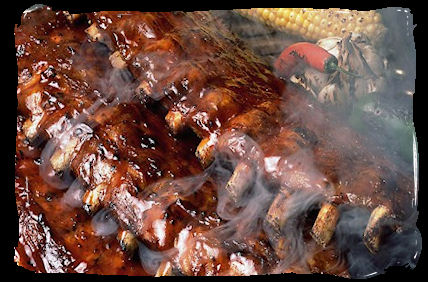
Wood smoke is a colloidal aerosol which contains solid particles, liquid droplets and vapor. The vapor is invisible but contains the compounds which give the characteristic flavor that we expect of smoked food. This means that if you can see it, you don't want it. Prior studies showed that solid and liquid particles did not contribute significantly to the flavor of smoked food. Solid particles, which are visible, were shown to absorb compounds from the liquid and vapor to form solids which were deposited on the food as "tarry deposits".

About 40% of the moisture in the smoke is made up of acids, the major one being acetic which give the tart flavor to smoked food. About 25% of the smoke is carbonyls which is mostly ketones and aldehydes (bad news guys). Around 16 % of wood smoke is made up of phenolics, various phenols, eugenols and vanillins. The carbonyls and phenols provide color and phenol is a preservative. Phenol is the source of the dominant odor, and the effectiveness, of the well known bathroom disinfectant, .............. Lysol.

Desirable, invisible, smoke flavor is deposited upon the surface of the meat then it is dissolved and diffused into the tissues. Acids accelerate the deposition, as does the difference between the food temperature and the temperature inside the grill. Therefore, early when the meat is just starting to cook, more flavor is deposited than later when the exterior of the meat approaches the temperature of the gasses in the grill.

Higher temperatures darken the surface of the food more than moderate temperatures. But the most important consideration in generating desirable smoke flavor is moisture content. A moist surface will absorb flavor while a dry surface will only attract tarry deposits. Thus, basting with a slightly acidic sauce will aid in the flavoring two ways. If the surface is kept moist and the temperature is moderate, barbecuing temperature -180-210 degrees, the absorption of beneficial flavors will continue and the color will be lighter than that cooked in higher temperatures with the deposition of tarry phenols and cresols.

At high temperatures, the maximum smoke deposition occurs rather quickly then stops. Lower temperatures extend the smoke deposition up to two hours, but most deposition occurs within the first hour. Meat and fish roasted and barbecued will get all the good smoke within the first couple of hours. Smoke after that will deteriorate the flavor.

When broiling, most of the flavor will be the result of the invisible vapors emanating from glowing embers. Throwing green/damp wood on immediately prior to putting the food on will generate more vapors, while the dense smoke is just passing by.

So the next time you see a grill belching dark smoke like an old coal fired railroad engine, have pity on the folk who have to eat the food. A faint wisp is all it takes.

Have fun,

Smoky
C. Clark Hale
8168 Hwy 98 E.
McComb, MS 39648

Hammock
Smoky's 5th basic position for really great barbecue'n.

Return to Smoky's Columns

'According to Smoky' is © by C. Clark Hale
who is solely responsible for its content. Comments
should be addresses to cchale@bellsouth.net


The Barbecue Store
New Sale Items
all the time! Check out
what's hot in outdoor cooking

For all of your gas grill parts
We have a large selection of replacement parts for almost any type of gas grill

Traeger Wood Pellet Grills
Click Here to request free catalog from Traeger Wood Pellet Grills. Learn more about the benefits of using a pellet grill.

Barbecue'n Guy!Barbecue'n On The Internet has been serving millions and millions of satisfied readers every year since February 3, 1996

Smoke 'n Fire Enquirer
 

See Our Privacy
Policy Here

Sign up for our newsletter today and begin preparing better barbecue and grilling meals today. It's totally free and contains more great outdoor cooking information.


Sample Newsletter

Email address:

First name:

Last name:

Names are really important to identify you
as we give free stuff away in our newsletters!
Subscribe   Unsubscribe  
      

image
image
image